Why your call brief should say less than you know
A brief that guesses gets you caught in the first minute. How Sales Legend ties every claim to a line of your own research, and why only the opener is scripted.
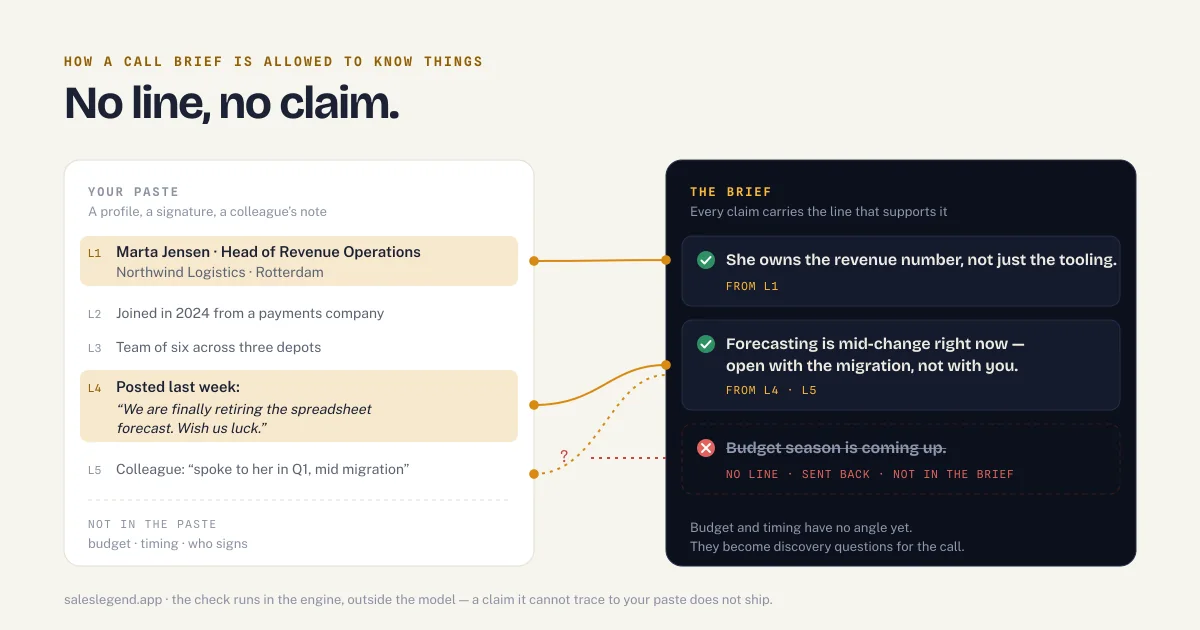
The most dangerous sentence in a call brief is the one that sounds right. “They’re scaling the sales team.” “Budget season is coming up.” “The VP owns the number.” Each one is plausible. Each one is the kind of thing a research tool produces when it has read a LinkedIn headline and nothing else. And each one, said out loud to the person it is about, can end the call.
Cold calling has a twelve-second problem: after “hello”, you have about that long before the other person decides whether this is a conversation or an interruption. A brief that makes you confident is good. A brief that makes you confidently wrong is worse than no brief at all, because the prospect now knows you did not actually do the work.
This is the design problem behind Sales Legend’s call brief, and the answer we landed on is unusual for a research tool: the brief is not allowed to know more than you do.
No line, no claim
A brief starts with a paste. A profile, an email signature, a colleague’s notes, a page from the company website. Whatever you have. From that, the model proposes pain hypotheses, an opener, discovery questions, objection battlecards and a qualification tracker.
Then the engine checks every prospect-specific claim against the paste. Not “does this sound like something that could be true of this person” but “which line of the paste says this”. Each claim carries the verbatim line that supports it. A claim with no supporting line is sent back to the model, and if the model cannot find one, the claim does not appear.
The consequence is a brief that sometimes says less than you hoped. If your paste is a job title and a company name, the brief will not invent a growth story. It will tell you the research has no angle yet and suggest what would give it one. That is a feature. A brief that hedges honestly at your desk beats one that gets caught on the phone.
Why this is harder than it sounds
Language models are built to complete patterns, and a sales brief is a very strong pattern. Given a title like “Head of Revenue Operations”, the statistically likely brief mentions forecasting accuracy, tooling sprawl and pipeline hygiene, because that is what briefs about that title usually say. None of it is about the person you are calling. All of it reads as insight.
Prompting alone does not fix this. Asking a model to “only use the provided information” reduces the problem; it does not remove it, because the model has no mechanical way to tell its own priors from your paste. The check has to live outside the model, in code that can compare a claim to a source and refuse. That is what the engine does, and it is why the brief shows you the supporting line rather than asking you to trust it.
The one line that is scripted
There is a deliberate exception to “guidance, not script”: the opener. The first sentence of the call is the one place where exact wording is the evidence. Gong’s analysis of its call corpus found that specific opening lines book meetings at measurably different rates, and those differences come from the words, not the intent behind them. So the brief gives you the opener word for word, built from what your research supports, and it credits the research it draws on inside the app.
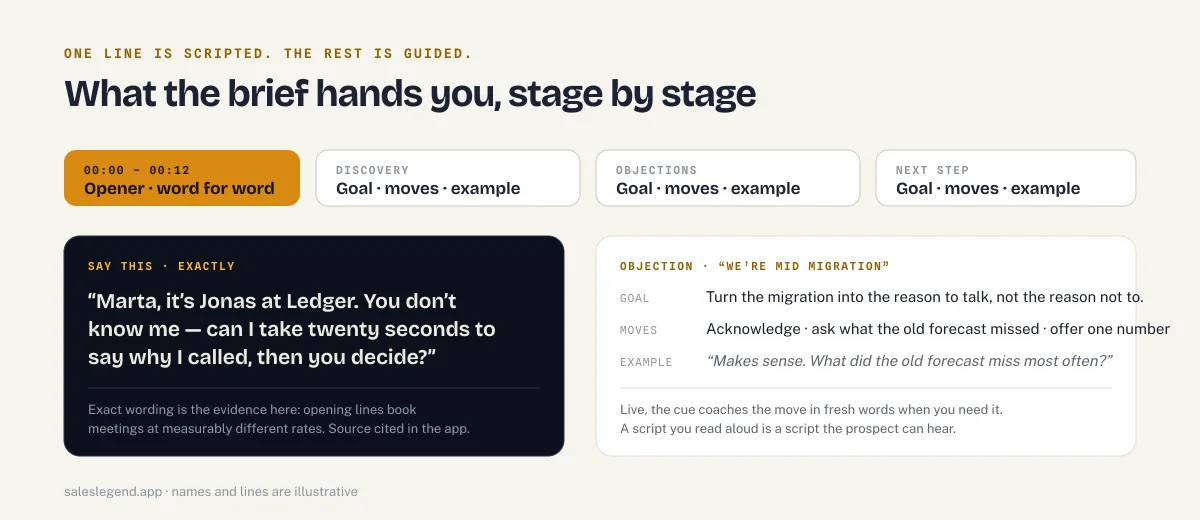
Everything after the opener is different. Objections do not arrive in the order a script expects. Discovery questions land or do not land depending on what was just said. For those, the brief gives you the goal of each stage, the moves that serve it and an example of what one might sound like, and the live cue coaches the move in fresh words when you need it. A script you read aloud is a script the prospect can hear.
What this means for how you research
If the brief can only say what your paste says, the paste becomes the lever. A few habits that make a difference:
- Paste more than the headline. The “about” section, a recent post, the company’s own description of what it sells. Each is a line the brief can stand on.
- Paste a colleague’s note verbatim. “Spoke to her last quarter, they were mid migration” is worth more than any inference, and the brief will cite it as such.
- Read the empty spaces. When the brief says it has no angle on budget or timing, that is a discovery question for the call, not a gap to paper over.
None of this requires the app. The principle travels: before you dial, look at your notes and ask, for each thing you believe about this person, which line told you that. If you cannot point at one, you are about to say something plausible. Say less.
Practise the brief before you trust it
The brief is also what the practice room runs on. The AI prospect you rehearse against is built from the same paste and the same claims, so when it pushes back on your opener or stalls on a question, it does so as the person your research describes, not as a generic buyer. If the brief was thin, the practice call will feel thin too, and you will know it an hour before the real dial rather than twelve seconds into it.